


口
| ||||||||
 | ||||||||
 међународно
 међународно
| Редослед писања | |||
|---|---|---|---|

| |||
| Редослед писања | |||
|---|---|---|---|

| |||
Han character

口 (Kangxi radical 30, 口+0, 3 strokes, cangjie input 口 (R), четири-угла 60000, composition ⿱冂一)
- Кангци радикал #30, ⼝.
- Shuowen Jiezi radical №22
Usage notes
This character (口) is used within characters. If a square is used as an enclosure around another character, then the character 囗 (U+56D7) is used instead.
Derived characters
- Додатак:Кинески радикал/口
- 㐰, 加, 𫭙, 如, 𪪺, 扣, 𬇖, 𨑕, 𪱳, 𣬣, 𤘘, 知, 𬖏, 𫃜, 𦒵, 𦔻, 𧥣(𬣚), 𧺚, 釦(𬬪), 卟, 𨙫, 鳴(鸣), 𪚩
- 兄, 𢗀, 𣬦, 肙, 足, 𭯶, 𤆗, 邑, 𭺲, 𤿌, 𡶸, 黾, 虽, 𧘗, 𨈗
- 占, 夻, 𡥄, 𢀛, 舌, 𦬅, 𣅊, 杏, 𣬧, 𬉸, 𭶻, 言, 𬽅, 𧮫, 谷, 𠔌, 𣄮, 𬔭, 𠭀, 𨈖, 軎, 害, 兽, 噕, 轡(辔), 石, 𡰪, 𢇞, 𫊝, 倉, 𫸧, 戓, 耉, 冋, 问, 冏, 局, 尚, 回, 中
Further reading
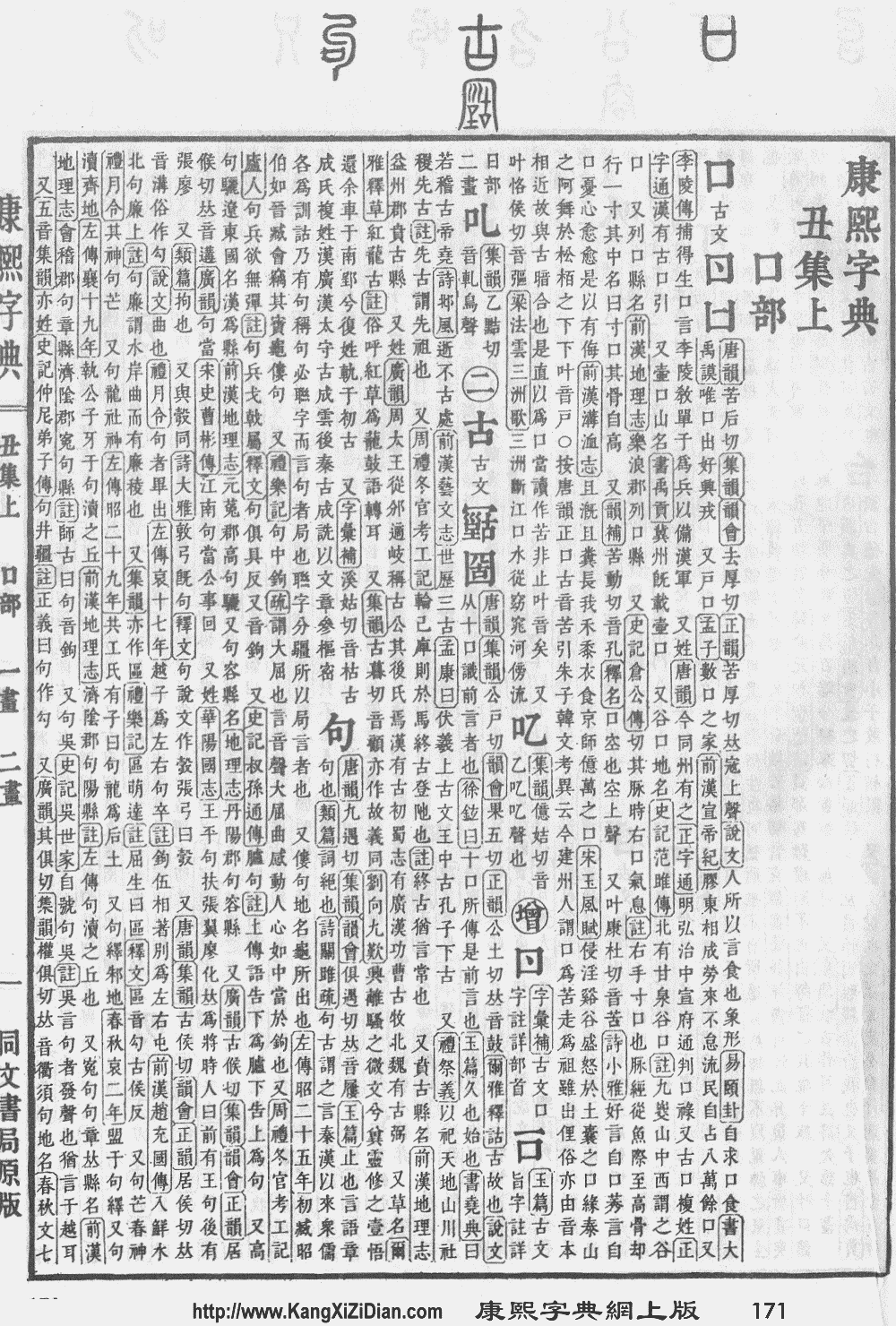
- KangXi: page 171, карактер 1
- Dai Kanwa Jiten: карактер 3227
- Dae Jaweon: страна 379, карактер 17
- Hanyu Da Zidian: том 1, страна 566, карактер 14
- Unihan data за U+53E3
Chinese
| једн. and трад. |
口 | |
|---|---|---|
| alternative forms | 𠙵 𠮚 | |

Glyph origin
| Историјски облици карактера 口 | ||||
|---|---|---|---|---|
| Shang | Warring States | Shuowen Jiezi (compiled in Han) | Liushutong (compiled in Ming) | |
| Bronze inscriptions | Oracle bone script | Chu Slip and silk script | Small seal script | Transcribed ancient scripts |

|

|

|

|

|
| Знакови у истом фонетском низу (口) (Zhengzhang, 2003) | |
|---|---|
| Стари Кинески | |
| 口 | |
| 叩 | |
| 扣 | |
| 釦 | |
| 筘 | |
Pictogram (象形 (xiàngxíng)) – resembles an open mouth.
In the oracle bone script, radical 口 is used for characters having abstract meanings. Such a character can have a figurative meaning derived from the phonetic part, e.g. 右 (“right”) = 又 (“right hand”) + 口 and 𪪺 (“strong; powerful”) = 弓 (“bow”) + 口, or be an unrelated borrowing, e.g. 否 (“no”) = 不 (“calyx”) + 口.
Etymology 1
From Proto-Sino-Tibetan *ku(w) (“mouth”). Cognate with Garo ku·sik (“mouth”), Lua грешка in Модул:languages/doSubstitutions at line 80: Substitution data 'txg-translit' does not match an existing module...
Pronunciation
Lua грешка in Модул:wuu-pron at line 162: Incorrect tone notation "2" for sh. See WT:AZH/Wu..
Definitions
口
- (anatomy) mouth, especially the lips and internal mouth cavity (Класификатор: 把 c)
- entrance; opening; mouth (of an object)
- gateway
- hole; cut
- port
- perimeter
- government organ; department
- Класификатор за family members, populations and guns.
- Класификатор за bites or mouthfuls.
- (neologism, slang) to fellate
- A презиме..
Synonyms
Compounds
Descendants
Etymology 2
| За изговор и дефиниције од 口 – види 名. (Овај character, 口, је an ancient облик од 名.) |
References
Japanese
Kanji
Readings
Compounds
Etymology 1
| Kanji in this term |
|---|
| 口 |
| くつ Степен: 1 |
| kun'yomi |
/kutu/ → /kut͡su/
From Old Japanese. Appears in compound terms listed in the Wamyō Ruijushō of 938 CE.
The ancient combining form of modern reading kuchi.[1] Likely the original form.
No longer productive in modern Japanese. Only found in older compounds.
There are interesting potential phonetic and semantic overlaps with Middle Chinese 窟 (“hole; cave”), 口 (“mouth; opening; hole”); Корејски 굳 (gut), 굿 (gut, “hole; hollow; cavity”); possibly even Ainu クㇳ (kut), クッチ (kutchi, “throat”). One possibility is that these represent prehistoric nativized borrowings from Chinese. However, there is yet no clear evidence of relatedness.
Pronunciation
Lua грешка in Модул:ja-pron at line 78: Parameter "yomi" is not used by this template..
- The pitch accent is derived from the entire compound word.
Noun
口 (kutsu)
Derived terms
Etymology 2
| Kanji in this term |
|---|
| 口 |
| くち Степен: 1 |
| kun'yomi |
*/kutu i/ → /kuti/ → /kut͡ɕi/
From Old Japanese, ultimately from Proto-Japonic *kutuy. Appears in the Man'yōshū, completed some time after 759 CE.[2]
Shift from kutu above, probably by fusion with ancient nominal particle い (i). Compare the phonetic development of 神 (kami, “spirit, god”) from kamu + i, 木 (ki, “tree”) from ko + i, 目 (me, “eye”) from ma + i.
Pronunciation
Lua грешка in Модул:ja-pron at line 78: Parameter "yomi" is not used by this template..
Noun
口 (kuchi)
- mouth
- 1999 јул 22, “グレード・ビル [Great Bill]”, in Vol.4, Konami:
- どんなものでも丸飲みできる大きな口を持っている。
- Donna mono de mo marunomi dekiru ōkina kuchi o motteiru.
- Its massive mouth can swallow whole anything whole.
- どんなものでも丸飲みできる大きな口を持っている。
- opening
- This term needs a translation to English. Please help out and add a translation, then remove the text
{{rfdef}}.- 書き口
- kakikuchi
- (please add an English translation of this example)
- 書き口
- This term needs a translation to English. Please help out and add a translation, then remove the text
{{rfdef}}. - taste (in food), preference
- 日本人の口に合わせた料理
- Nihonjin no kuchi ni awaseta ryōri
- food adapted to Japanese tastes
- 日本人の口に合わせた料理
Derived terms
Etymology 3
| Kanji in this term |
|---|
| 口 |
| く Степен: 1 |
| on'yomi |
From Middle Chinese 口. The 呉音 (goon), so likely the initial borrowing.
Pronunciation
Lua грешка in Модул:ja-pron at line 78: Parameter "yomi" is not used by this template..
Noun
口 (ku)
Counter
口 (-ku)
- used to count people
- used to count per-person portions
- used to count open-mouthed containers
- used to count bladed weapons or tools
Etymology 4
| Kanji in this term |
|---|
| 口 |
| こう Степен: 1 |
| on'yomi |
From Middle Chinese 口. The 漢音 (kan'on), so likely a later borrowing.
Pronunciation
Lua грешка in Модул:ja-pron at line 78: Parameter "yomi" is not used by this template..
Counter
口 (-kō)
- used to count people
- used to count bladed weapons or tools
References
Korean
Etymology
From Middle Chinese 口.
| Historical readings |
|---|
|
Pronunciation
- (in 口文, 口錢, and 口硬):
- (SK Standard/Seoul) IPA(кључ): [ku]
- Phonetic hangul: [구]
- (mouth; entrance; hole; etc.):
- (SK Standard/Seoul) IPA(кључ): [ku(ː)]
- Phonetic hangul: [구(ː)]
- Though still prescribed in Standard Korean, most speakers in both Koreas no longer distinguish vowel length.
Hanja

Compounds
- 인구 (人口, in'gu)
- 가구 (家口, gagu)
- 구결 (口訣, gugyeol)
- 구호 (口號, guho)
- 창구 (窓口, changgu)
- 함구 (緘口, hamgu)
- 구실 (口實, gusil)
- 구미 (口味, gumi)
- 항구 (港口, hanggu)
- 입구 (入口, ipgu)
- 구술 (口述, gusul)
- 금구 (噤口, geumgu)
- 구두 (口頭, gudu)
- 출구 (出口, chulgu)
- 하구 (河口, hagu)
- 대구 (大口, daegu)
- 구화 (口話, guhwa)
- 식구 (食口, sikgu)
- 구전 (口錢, gujeon)
- 구문 (口文, gumun)
- 구어 (口語, gueo)
- 구전 (口傳, gujeon)
- 화구 (火口, hwagu)
- 포구 (浦口, pogu)
- 강구 (江口, ganggu)
- 도구 (渡口, dogu)
- 구순 (口脣, gusun)
- 구령 (口令, guryeong)
- 구수 (口數, gusu)
- 갱구 (坑口, gaenggu)
- 구강 (口腔, gugang)
- 구설 (口舌, guseol)
- 호구 (戶口, hogu)
- 경구 (經口, gyeonggu)
- 구각 (口角, gugak)
- 구답 (口答, gudap)
References
- 국제퇴계학회 대구경북지부 (國際退溪學會 大邱慶北支部) (2007). Digital Hanja Dictionary, 전자사전/電子字典. [1]
Kunigami
Kanji
口
Readings
Pronunciation
Noun
口 (hiragana くちー, rōmaji khuchī)
Miyako
Kanji
口
Readings
Pronunciation
Noun
口 (hiragana ふつ, rōmaji futsu, alternative reading ふィちィ, rōmaji fïchï)
References
Okinawan
Kanji
Readings
Pronunciation
Noun
Compounds
- 沖縄口 (uchināguchi, “Okinawan language”)
- ウランダ口 (urandaguchi, “European language, Western language”)
- 書ち口 (kachiguchi, “written language”)
- 口しば (kuchishiba, “lips”)
- 島口 (shimaguchi, “island language, local language”)
- 唐口 (tōguchi, “Chinese language”)
- 那覇口 (nāfaguchi, “Naha dialect”)
- 目口 (mīkuchi, “facial expression”)
- 大和口 (yamatuguchi, “standard Japanese language”)
References
- Шаблон:R:JLect
- “クチ” in Okinawa Center of Language Study, Shuri-Naha Dialect Dictionary (archived; reopens 2024).
Vietnamese
Han character
口: Hán Việt readings: khẩu-tdcntd;gdhn
口: Nôm readings: khẩu-tdcntd;gdhn
References
Yaeyama
Kanji
口
Readings
Pronunciation
Noun
口 (hiragana ふつぃ, rōmaji futsï)
Yonaguni
Kanji
口
Readings
Pronunciation
Noun
口 (кинески)
Изговор:
- пинјин: kǒu
Шаблон:zh-cirАудио: 
(датотека)

Радикал:
- ⼝ 030
Значења:
- ...
Примери:
Синоними:
- ...
Хомофони:
- ...
Хомографи:
- ...
ХСК ниво:
- ...
Асоцијације:
- ...
Изведене речи:
- ...
Сродни чланци са Википедије:
Преводи
|
|
Референце
Спољашње Везе
Претходна Страна Наредна
Листа 口: 口
⼝ 000 古 001 句 002 另 003 叧 004 叨 005 叩 006 只 007 叫 008 召 009 叭 010 叮 011 可 012 台 013 叱 014 史 015 右 016 叴 017 叵 018 叶 019 号 020 司 021 叹 022 叺 023 叻 024 叼 025 叽 026 叾 027 叿 028 吀 029 吁 030 吂 031 吃 032 各 033 吅 034 吆 035 吇 036 合 037 吉 038 吊 039 吋 040 同 041 名 042 后 043 吏 044 吐 045 向 046 吒 047 吓 048 吔 049 吕 050 吖 051 吗 052 吘 053 吙 054 吚 055 君 056 吜 057 吝 058 吞 059 吟 060 吠 061 吡 062 吢 063 吣 064 吤 065 吥 066 否 067 吧 068 吨 069 吩 070 吪 071 含 072 听 073 吭 074 吮 075 启 076 吰 077 吱 078 吲 079 吳 080 吴 081 吵 082 吶 083 吷 084 吸 085 吹 086 吺 087 吻 088 吼 089 吽 090 吾 091 吿 092 呀 093 呁 094 呂 095 呃 096 呄 097 呅 098 呆 099 呇 100 呈 101 呉 102 告 103 呋 104 呌 105 呍 106 呎 107 呏 108 呐 109 呑 110 呒 111 呓 112 呔 113 呕 114 呖 115 呗 116 员 117 呙 118 呚 119 呛 120 呜 121 呝 122 呞 123 呟 124 呠 125 呡 126 呢 127 呣 128 呤 129 呥 130 呦 131 呧 132 周 133 呩 134 呪 135 呫 136 呬 137 呭 138 呮 139 呯 140 呰 141 呱 142 呲 143 味 144 呴 145 呵 146 呶 147 呷 148 呸 149 呹 150 呺 151 呻 152 呼 153 命 154 呾 155 呿 156 咀 157 咁 158 咂 159 咃 160 咄 161 咅 162 咆 163 咇 164 咈 165 咉 166 咊 167 咋 168 和 169 咍 170 咎 171 咏 172 咐 173 咑 174 咒 175 咓 176 咔 177 咕 178 咖 179 咗 180 咘 181 咙 182 咚 183 咛 184 咜 185 咝 186 咞 187 咟 188 咠 189 咡 190 咢 191 咣 192 咤 193 咥 194 咦 195 咧 196 咨 197 咩 198 咪 199 咫 200 咬 201 咭 202 咮 203 咯 204 咰 205 咱 206 咲 207 咳 208 咴 209 咵 210 咶 211 咷 212 咸 213 咹 214 咺 215 咻 216 咼 217 咽 218 咾 219 咿 220 哀 221 品 222 哂 223 哃 224 哄 225 哅 226 哆 227 哇 228 哈 229 哉 230 哊 231 哋 232 哌 233 响 234 哎 235 哏 236 哐 237 哑 238 哒 239 哓 240 哔 241 哕 242 哖 243 哗 244 哘 245 哙 246 哚 247 哛 248 哜 249 哝 250 哞 251 哟 252 哠 253 員 254 哢 255 哣 256 哤 257 哥 258 哦 259 哧 260 哨 261 哩 262 哪 263 哫 264 哬 265 哭 266 哮 267 哯 268 哰 269 哱 270 哲 271 哳 272 哴 273 哵 274 哶 275 哷 276 哸 277 哹 278 哺 279 哻 280 哼 281 哽 282 哾 283 哿 284 唀 285 唁 286 唂 287 唃 288 唄 289 唅 290 唆 291 唇 292 唈 293 唉 294 唊 295 唋 296 唌 297 唍 298 唎 299 唏 300 唐 301 唑 302 唒 303 唓 304 唔 305 唕 306 唖 307 唗 308 唘 309 唙 310 唚 311 唛 312 唜 313 唝 314 唞 315 唟 316 唠 317 唡 318 唢 319 唣 320 唤 321 唥 322 唦 323 唧 324 唨 325 唩 326 唪 327 唫 328 唬 329 唭 330 售 331 唯 332 唰 333 唱 334 唲 335 唳 336 唴 337 唵 338 唶 339 唷 340 唸 341 唹 342 唺 343 唻 344 唼 345 唽 346 唾 347 唿 348 啀 349 啁 350 啂 351 啃 352 啄 353 啅 354 商 355 啇 356 啈 357 啉 358 啊 359 啋 360 啌 361 啍 362 啎 363 問 364 啐 365 啑 366 啒 367 啓 368 啔 369 啕 370 啖 371 啗 372 啘 373 啙 374 啚 375 啛 376 啜 377 啝 378 啞 379 啟 380 啠 381 啡 382 啢 383 啣 384 啤 385 啥 386 啦 387 啧 388 啨 389 啩 390 啪 391 啫 392 啬 393 啭 394 啮 395 啯 396 啰 397 啱 398 啲 399 啳 400 啴 401 啵 402 啶 403 啷 404 啸 405 啹 406 啺 407 啻 408 啼 409 啽 410 啾 411 啿 412 喀 413 喁 414 喂 415 喃 416 善 417 喅 418 喆 419 喇 420 喈 421 喉 422 喊 423 喋 424 喌 425 喍 426 喎 427 喏 428 喐 429 喑 430 喒 431 喓 432 喔 433 喕 434 喖 435 喗 436 喘 437 喙 438 喚 439 喛 440 喜 441 喝 442 喞 443 喟 444 喠 445 喡 446 喢 447 喣 448 喤 449 喥 450 喦 451 喧 452 喨 453 喩 454 喪 455 喫 456 喬 457 喭 458 單 459 喯 460 喰 461 喱 462 喲 463 喳 464 喴 465 喵 466 営 467 喷 468 喸 469 喹 470 喺 471 喻 472 喼 473 喽 474 喾 475 喿 476 嗀 477 嗁 478 嗂 479 嗃 480 嗄 481 嗅 482 嗆 483 嗇 484 嗈 485 嗉 486 嗊 487 嗋 488 嗌 489 嗍 490 嗎 491 嗏 492 嗐 493 嗑 494 嗒 495 嗓 496 嗔 497 嗕 498 嗖 499 嗗 500 嗘 501 嗙 502 嗚 503 嗛 504 嗜 505 嗝 506 嗞 507 嗟 508 嗠 509 嗡 510 嗢 511 嗣 512 嗤 513 嗥 514 嗦 515 嗧 516 嗨 517 嗩 518 嗪 519 嗫 520 嗬 521 嗭 522 嗮 523 嗯 524 嗰 525 嗱 526 嗲 527 嗳 528 嗴 529 嗵 530 嗶 531 嗷 532 嗸 533 嗹 534 嗺 535 嗻 536 嗼 537 嗽 538 嗾 540 嗿 541 嘀 542 嘁 543 嘂 544 嘃 545 嘄 546 嘅 547 嘆 548 嘇 549 嘈 550 嘉 551 嘊 552 嘋 553 嘌 554 嘍 555 嘎 556 嘏 557 嘐 558 嘑 559 嘒 560 嘓 561 嘔 562 嘕 563 嘖 564 嘗 565 嘘 566 嘙 567 嘚 568 嘛 569 嘜 570 嘝 571 嘞 572 嘟 573 嘠 574 嘡 575 嘢 576 嘣 577 嘤 578 嘥 579 嘦 580 嘧 581 嘨 582 嘩 583 嘪 584 嘫 585 嘬 586 嘭 587 嘮 588 嘯 589 嘰 590 嘱 591 嘲 592 嘳 593 嘴 594 嘵 595 嘶 596 嘷 597 嘸 598 嘹 599 嘺 600 嘻 601 嘼 602 嘽 603 嘾 604 嘿 605 噀 606 噁 607 噂 608 噃 609 噄 610 噅 611 噆 612 噇 613 噈 614 噉 615 噊 616 噋 617 噌 618 噍 619 噎 620 噏 621 噐 622 噑 623 噒 624 噓 625 噔 626 噕 627 噖 628 噗 629 噘 630 噙 631 噚 632 噛 633 噜 634 噝 635 噞 636 噟 637 噠 638 噡 639 噢 640 噣 641 噤 642 噥 643 噦 644 噧 645 器 646 噩 647 噪 648 噫 649 噬 650 噭 651 噮 652 噯 653 噰 654 噱 655 噲 656 噳 657 噴 658 噵 659 噶 660 噷 661 噸 662 噹 663 噺 664 噻 665 噼 666 噽 667 噾 668 噿 669 嚀 670 嚁 671 嚂 672 嚃 673 嚄 674 嚅 675 嚆 676 嚇 677 嚈 678 嚉 679 嚊 680 嚋 681 嚌 682 嚍 683 嚎 684 嚏 685 嚐 686 嚑 687 嚒 688 嚓 689 嚔 690 嚕 691 嚖 692 嚗 693 嚘 694 嚙 695 嚚 696 嚛 697 嚜 698 嚝 699 嚞 700 嚟 701 嚠 702 嚡 703 嚢 704 嚣 705 嚤 706 嚥 707 嚦 708 嚧 709 嚨 710 嚩 711 嚪 712 嚫 713 嚬 714 嚭 715 嚮 716 嚯 717 嚰 718 嚱 719 嚲 720 嚳 721 嚴 722 嚵 723 嚶 724 嚷 725 嚸 726 嚹 727 嚺 728 嚻 729 嚼 730 嚽 731 嚾 732 嚿 733 囀 734 囁 735 囂 736 囃 737 囄 738 囅 739 囆 740 囇 741 囈 742 囉 743 囊 744 囋 745 囌 746 囍 747 囎 748 囏 749 囐 750 囑 751 囒 752 囓 753 囔 754 囕 755 囖 756
- Странице са грешкама у скрипти
- CJK Unified Ideographs блок
- Han script characters
- Карактер оквири са сликама
- Kangxi Radicals блок
- Међународни говор
- Међународни леме
- Међународни symbols
- Међународни terms with redundant script codes
- Међународни terms with redundant head parameter
- Међународни terms with non-redundant non-automated sortkeys
- Стране са 12 уноса
- Стране са language headings in the wrong order
- Стране са nonstandard language headings
- Стране са raw sortkeys
- Хан текст карактери
- Shuowen radicals
- CJKV radicals
- Хан пиктограми
- Кинески изрази наслеђени од Proto-Sino-Tibetan
- Кинески термини изведени од Proto-Sino-Tibetan
- Кинески Хан карактери
- zh:Anatomy
- Кинески именице класификоване по 把
- Мандарин terms with usage examples
- Кинески neologisms
- Кинески slang
- Мандарин terms with quotations
- Кинески презимена
- Кинески црвене везе/zh-see
- zh:Beginning
- Јапански terms with redundant transliterations
- Јапански terms with non-redundant manual transliterations
- Јапански kanji with goon reading く
- Јапански kanji with kan'on reading こう
- Јапански kanji with kun reading くち
- Јапански kanji with kun reading くつ
- Јапански термини који се пишу са 口 читани као くつ
- Јапански термини читани са kun'yomi
- Јапански terms with non-redundant non-automated sortkeys
- Јапански изрази наслеђени од Old Japanese
- Јапански термини изведени од Old Japanese
- Јапански links with redundant wikilinks
- Јапански именице
- Јапански terms spelled with first grade kanji
- Јапански terms written with one Han script character
- Јапански terms spelled with 口
- Јапански single-kanji terms
- Јапански термини који се пишу са 口 читани као くち
- Јапански изрази наслеђени од Proto-Japonic
- Јапански термини изведени од Proto-Japonic
- Јапански links with redundant alt parameters
- Japanese terms with usage examples
- Јапански термини са примерима коришћења
- Захтеви за дефиниције у Јапанским ставкама
- Requests for translations of Japanese usage examples
- Јапански термини који се пишу са 口 читани као く
- Јапански термини читани са on'yomi
- Јапански термини изведени од Middle Chinese
- ja:Buddhism
- Јапански леме
- Јапански counters
- Јапански термини који се пишу са 口 читани као こう
- Корејски термини изведени од Middle Chinese
- Корејски links with redundant wikilinks
- Middle Korean Han characters
- Korean terms with long vowels in the first syllable
- Корејски terms with redundant script codes
- Корејски Хан карактери
- Корејски terms with non-redundant non-automated sortkeys
- Kunigami леме
- Kunigami Han characters
- Japanese kanji using old ja-readings format
- Kunigami термини са ИПА изговором
- Kunigami terms with non-redundant non-automated sortkeys
- Kunigami noun
- Kunigami уноси са нетачним заглављем језика
- xug:Anatomy
- xug:Linguistics
- xug:Talking
- Miyako леме
- Miyako Han characters
- Miyako термини са ИПА изговором
- Miyako terms with non-redundant non-automated sortkeys
- Miyako noun
- mvi:Anatomy
- mvi:Linguistics
- mvi:Talking
- Okinawan Han characters
- Grade 1 kanji
- Okinawan terms with redundant transliterations
- Okinawan kanji with kun reading くち
- Okinawan kanji with kun readings missing okurigana designation
- Okinawan термини са ИПА изговором
- Okinawan terms with redundant sortkeys
- Okinawan леме
- Okinawan nouns
- Okinawan terms spelled with first grade kanji
- Okinawan terms written with one Han script character
- Okinawan terms spelled with 口
- Okinawan single-kanji terms
- Okinawan terms with redundant script codes
- Okinawan terms with redundant head parameter
- Okinawan terms with non-redundant non-automated sortkeys
- Okinawan terms with non-redundant manual transliterations
- ryu:Anatomy
- ryu:Linguistics
- ryu:Talking
- Vietnamese Han tu
- Vietnamese Nom
- Yaeyama леме
- Yaeyama Han characters
- Yaeyama термини са ИПА изговором
- Yaeyama terms with non-redundant non-automated sortkeys
- Yaeyama noun
- Yaeyama уноси са нетачним заглављем језика
- rys:Anatomy
- rys:Linguistics
- rys:Talking
- Yonaguni леме
- Yonaguni Han characters
- Yonaguni термини са ИПА изговором
- Yonaguni terms with non-redundant non-automated sortkeys
- Yonaguni noun
- Yonaguni уноси са нетачним заглављем језика
- yoi:Anatomy
- yoi:Linguistics
- yoi:Talking
- Кинеска реч
- Речи направљене аутоматизмом
- Радикал
- Радикал 030- 口
- 52 - радикала
- 3 потеза