


把
| ||||||||
 međunarodno
 međunarodno
| Redosled pisanja | |||
|---|---|---|---|

| |||
Han character
把 (Kangxi radical 64, 手+4, 7 strokes, cangjie input 手日山 (QAU), četiri-ugla 57017, composition ⿰扌巴)
References
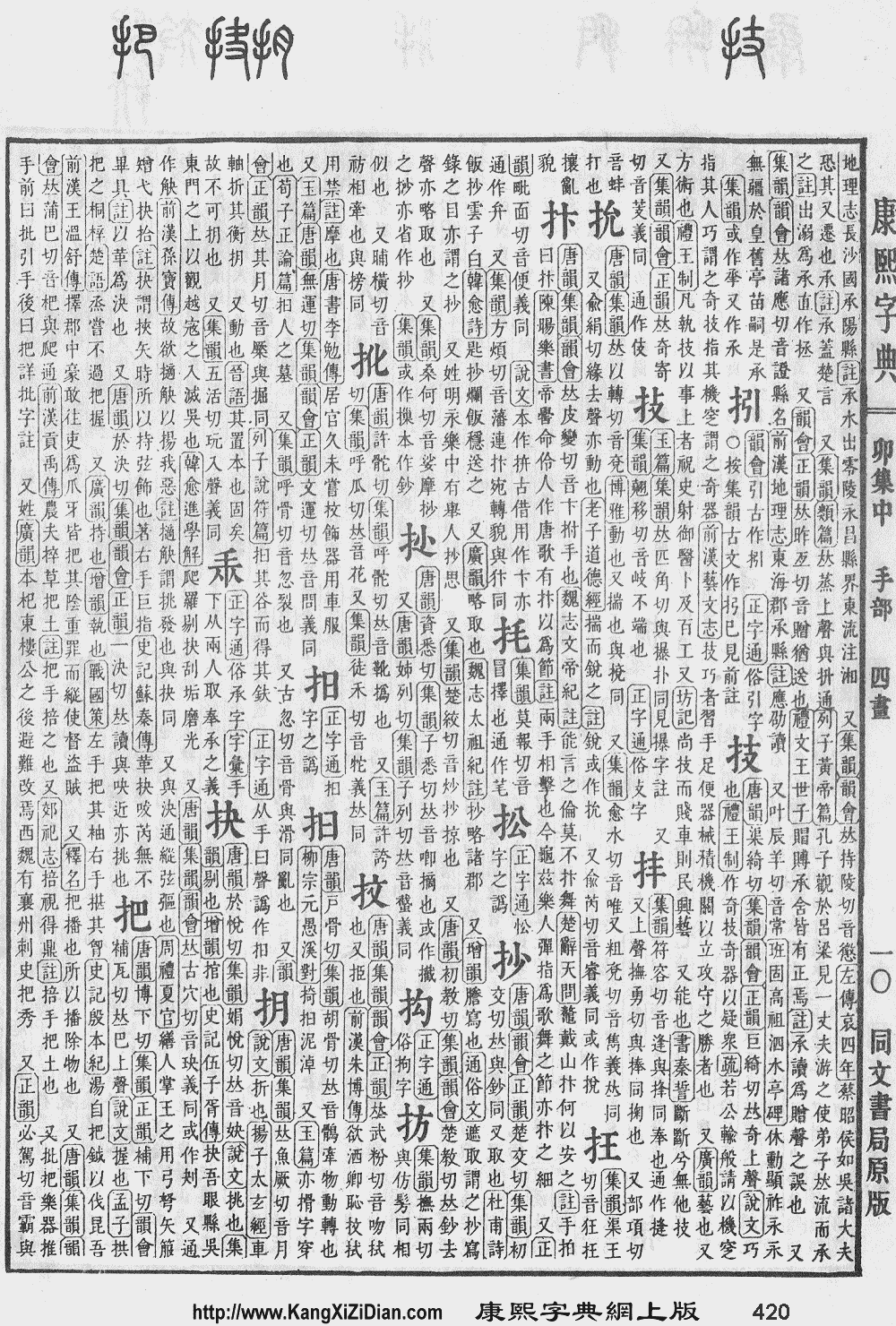
- KangXi: page 420, karakter 21
- Dai Kanwa Jiten: karakter 11874
- Dae Jaweon: strana 768, karakter 1
- Hanyu Da Zidian: tom 3, strana 1845, karakter 4
- Unihan data za U+628A
 Kineski
 Kineski
| jedn. and trad. |
把 | |
|---|---|---|
Glyph origin
| Znakovi u istom fonetskom nizu (巴) (Zhengzhang, 2003) | |
|---|---|
| Stari Kineski | |
| 巴 | |
| 芭 | |
| 笆 | |
| 豝 | |
| 鈀 | |
| 吧 | |
| 蚆 | |
| 疤 | |
| 把 | |
| 爸 | |
| 弝 | |
| 靶 | |
| 葩 | |
| 舥 | |
| 妑 | |
| 帊 | |
| 琶 | |
| 爬 | |
| 杷 | |
| 跁 | |
| 耙 | |
Phono-semantic compound (形聲/形声 (xíngshēng)) : semantic 扌 (“hand”) + phonetic 巴.
Pronunciation 1
Definitions
把
- to hold; to grasp; to take
- 縱有健婦把鋤犁,禾生隴畝無東西。 [Classical Chinese, trad.]
- From: 8th century, 杜甫 (Du Fu), 《兵車行》 (The Army Wagons: A Ballad); translated by Stephen Owen
- Zòng yǒu jiànfù bǎ chúlí, hé shēng lǒngmǔ wú dōngxī. [Pinyin]
- Even though there are sturdy wives to hold the hoe and plow, the grain grows on the field boundary slopes and one can’t tell east from west.
纵有健妇把锄犁,禾生陇亩无东西。 [Classical Chinese, simp.]
- to control; to dominate
- 把控 ― bǎkòng ― to control
- to guard; to have control over
- (colloquial) to be close; to be near
- to hold a baby while it relieves itself
- 把尿 ― bǎniào ― to hold a baby while it urinates
- (traditional Chinese medicine) to feel (for the pulse)
- A light verb or preposition placed before the object of a sentence to allow it to be placed before the verb, giving greater flexibility in complex sentence construction.
- Used before a “subject + verb + complement” structure; to cause to; to make
- bundle; bunch
- 火把 ― huǒbǎ ― torch (stick with a flame on one end)
- handle; knob; grip (a part of an object which is held in the hand)
- stem (of a flower, leaf, fruit, etc.)
- Classifier for objects that can be held using handles or knobs, such as guns, chairs, brooms, or umbrellas. ⇒ all nouns using this classifier
- 三把刀 ― sān bǎ dāo ― three knives
- 四把鉸剪/四把铰剪 [Cantonese] ― sei3 baa2 gaau3 zin2 [Jyutping] ― four pairs of scissors
- 一把刀囝 [Min Dong, trad. and simp.]
- From: Šablon:RQ:Great Dictionary of Modern Chinese Dialects
- siŏh bā dŏ̤-giāng / [suoʔ⁵ pa³³ to⁵⁵⁻⁵³ (k-)iaŋ³³] [Bàng-uâ-cê / IPA]
- a pocketknife
- 兩把掃把/两把扫把 ― liǎng bǎ sǎobǎ ― two brooms
- Classifier for handfuls of something, such as grains, soil.
- Classifier for bundles or bunches.
- Classifier for some abstract ideas, such as force, effort or age.
- Classifier for something done with the hand.
- (Xiamen and Quanzhou Hokkien) Classifier for wheeled vehicles.
- 一把跤踏車 [Min Nan, trad.]
- From: Šablon:RQ:Great Dictionary of Modern Chinese Dialects
- chi̍t pé kha踏車 [Pe̍h-ōe-jī]
- a bicycle
一把跤踏车 [Min Nan, simp.]
- Placed after numerals or classifiers to express uncertainty; approximately
- (dialectal) to give
- A prezime..
Usage notes

- A great deal of linguistic research has been carried out regarding the grammar of the "bǎ construction". Šablon:attn
Synonyms
Sinonimi od 把
Sinonimi od 把
- The dial-syn page 「把」 does not yet exist. Create the data page and the map!
- n 柄
- n
- The dial-syn page 「把-2」 does not yet exist. Create the data page and the map!
- The dial-syn page 「輛」 does not yet exist. Create the data page and the map!
- n
- The dial-syn page 「給」 does not yet exist. Create the data page and the map!
Compounds
Izvedeni termini od 把
|
|
|
Pronunciation 2
Definitions
把
 Japanski
 Japanski
Kanji
Lua greška in Modul:languages at line 1302: The function getByCode expects a string as its first argument, but received nil..
- Ovaj izraz zahteva definiciju. Molim vas pomozite i dodajte prevod, zatim uklonite tekst
{{rfdef}}.
Readings
Compounds
Etymology
| Kanji in this term |
|---|
| 把 |
| たば Stepen: S |
| kun’yomi |

Pronunciation
Lua greška in Modul:ja-pron at line 86: The parameter "yomi" is not used by this template..
Alternative forms
Counter
把 (-taba)
- counter for bundles
Noun
把 (taba)
References
 Korejski
 Korejski
Etymology
Od Middle Chinese 把.
| Historical readings |
|---|
|
Pronunciation
- (SK Standard/Seoul) IPA(key): [pʰa̠]
- Phonetic hangul: [파]
Hanja

Lua greška in Modul:headword at line 442: In full_headword(), `data.translits` must be an array but is a string.
Compounds
Compounds
- 파로 (把撈, paro)
- 파반 (把盤, paban)
- 파배 (把杯, pabae)
- 파속 (把束, pasok)
- 파수 (把守, pasu)
- 파수 (把手, pasu)
- 파악 (把握, paak)
- 파장 (把掌, pajang)
- 파절 (把截, pajeol)
- 파주 (把住, paju)
- 파지 (把持, paji)
- 파지 (把指, paji)
- 파직 (把直, pajik)
- 파착 (把捉, pachak)
- 파총 (把摠, pachong)
- 파필 (把筆, papil)
- 검파 (劍把, geompa)
- 견파 (肩把, gyeonpa)
- 공파 (拱把, gongpa)
- 도파 (刀把, dopa)
- 만파 (輓把, manpa)
- 복파 (腹把, bokpa)
- 슬파 (膝把, seulpa)
- 외파 (外把, oepa)
- 입파 (入把, ip'pa)
- 총파 (銃把, chongpa)
- 낭파초 (狼把草, nangpacho)
References
- 국제퇴계학회 대구경북지부 (國際退溪學會 大邱慶北支部) (2007). Digital Hanja Dictionary, 전자사전/電子字典. [1]
 Vijetnamski
 Vijetnamski
Han character
- Ovaj izraz zahteva definiciju. Molim vas pomozite i dodajte prevod, zatim uklonite tekst
{{rfdef}}.
把 (kineski)
Izgovor:
- pinjin: bǎ
Šablon:zh-cirAudio: 
(datoteka)

Radikal:
Značenja:
- 1. glagol: držati, stražariti, kontrolisati, uzeti, biti blizu, biti u blizini (nečega), osigurati
- 2. klasifikator za stvari koje se uzimaju rukom (nož, kišobran, stolica, šaka pirinča)
- 3. predlog koji stoji ispred neposrednog objekta, iza kojeg stoji prelazni glagol
- 4. prilog: otprilike, oko
Primeri:
- 他个把月把大门。 On otprilike mesec dana čuva kapiju.
- 请你把书递给我。Molim te, dodaj mi knjigu.
„Treća knjiga Mojsijeva,koja se zove Levitska,Glava 1”

HSK nivo
- 4
Srodni članci sa Vikipedije:
Prevodi
|
|
Reference
Kategorije:
- CJK jedinstveni ideogrami blok
- Međunarodni govor
- Međunarodni symbols
- Međunarodni terms with redundant head parameter
- Han tekst karakteri
- Kineski govor
- Han fono-semantična jedinjenja
- Mandarin pojmovi sa audio vezama
- Mandarin termini sa više izgovora
- Kineski leme
- Mandarin leme
- Dungan leme
- Kantonski leme
- Taishanese leme
- Gan leme
- Hakka leme
- Jin leme
- Min Bej leme
- Min Dong leme
- Min Nan leme
- Teochew leme
- Wu leme
- Xiang leme
- Kineski glagoli
- Mandarin glagoli
- Dungan glagoli
- Kantonski glagoli
- Taishanese glagoli
- Gan glagoli
- Hakka glagoli
- Jin glagoli
- Min Bej glagoli
- Min Dong glagoli
- Min Nan glagoli
- Teochew glagoli
- Wu glagoli
- Xiang glagoli
- Kineski imenice
- Mandarin imenice
- Dungan imenice
- Kantonski imenice
- Taishanese imenice
- Gan imenice
- Hakka imenice
- Jin imenice
- Min Bej imenice
- Min Dong imenice
- Min Nan imenice
- Teochew imenice
- Wu imenice
- Xiang imenice
- Kineski prepositions
- Mandarin prepositions
- Dungan prepositions
- Kantonski prepositions
- Taishanese prepositions
- Gan prepositions
- Hakka prepositions
- Jin prepositions
- Min Bej prepositions
- Min Dong prepositions
- Min Nan prepositions
- Teochew prepositions
- Wu prepositions
- Xiang prepositions
- Kineski klasifikatori
- Mandarin klasifikatori
- Dungan klasifikatori
- Kantonski klasifikatori
- Taishanese klasifikatori
- Gan klasifikatori
- Hakka klasifikatori
- Jin klasifikatori
- Min Bej klasifikatori
- Min Dong klasifikatori
- Min Nan klasifikatori
- Teochew klasifikatori
- Wu klasifikatori
- Xiang klasifikatori
- Kineski prilozi
- Mandarin prilozi
- Dungan prilozi
- Kantonski prilozi
- Taishanese prilozi
- Gan prilozi
- Hakka prilozi
- Jin prilozi
- Min Bej prilozi
- Min Dong prilozi
- Min Nan prilozi
- Teochew prilozi
- Wu prilozi
- Xiang prilozi
- Kineski vlastite imenice
- Mandarin vlastite imenice
- Dungan vlastite imenice
- Kantonski vlastite imenice
- Taishanese vlastite imenice
- Gan vlastite imenice
- Hakka vlastite imenice
- Jin vlastite imenice
- Min Bej vlastite imenice
- Min Dong vlastite imenice
- Min Nan vlastite imenice
- Teochew vlastite imenice
- Wu vlastite imenice
- Xiang vlastite imenice
- Kineski termini sa IPA izgovorom
- Kineski hanzi
- Kineski Han karakteris
- Mandarin terms with usage examples
- Literary Chinese terms with quotations
- Kineski colloquialisms
- zh:Traditional Chinese medicine
- Cantonese terms with usage examples
- Min Dong terms with quotations
- Xiamen Hokkien
- Quanzhou Hokkien
- Hokkien Chinese
- Min Nan terms with quotations
- Kineski dialectal terms
- Kineski prezimena
- Kineski crvene veze/zh-l
- Chinese terms with obsolete senses
- zh:Beginning
- Intermediate Mandarin
- Japanski indeks
- Zahtevi za definicije u Japanskim stavkama
- Terms with redundant transliterations
- Terms with redundant transliterations/ja
- Terms with manual transliterations different from the automated ones
- Terms with manual transliterations different from the automated ones/ja
- Japanski kanji with goon reading へ
- Japanski kanji with kan'on reading は
- Japanski kanji with kun reading たば
- Japanski kanji with kun reading つか
- Japanski kanji with kun readings missing okurigana designation
- Japanski terms spelled with 把 read as たば
- Japanski terms read with kun'yomi
- Zahtevi za etimologije u Japanskim stavkama
- Japanski lemmas
- Japanski counters
- Japanski terms spelled with secondary school kanji
- Japanski terms written with one Han script character
- Japanski terms spelled with 把
- Japanski single-kanji terms
- Japanski imenice
- Korejski govor
- Korejski pojmovi izvedeni iz Middle Chinese
- Vijetnamski govor
- Zahtevi za definicije u Vijetnamskim stavkama
- Kineska reč